HomeServicesOur workProductsAboutContact us

info@technomous.com · +92 333 0440459

Availability Insight: Snowflake-native on-shelf availability platform

Finding empty shelves sooner.

We built version 5 of Availability Insight as a Snowflake-native platform that turns sales, inventory and ranging data into daily alerts for grocery store teams.
  • Retail / Grocery
  • Data engineering
  • Software development
  • Project
Availability Insight case study
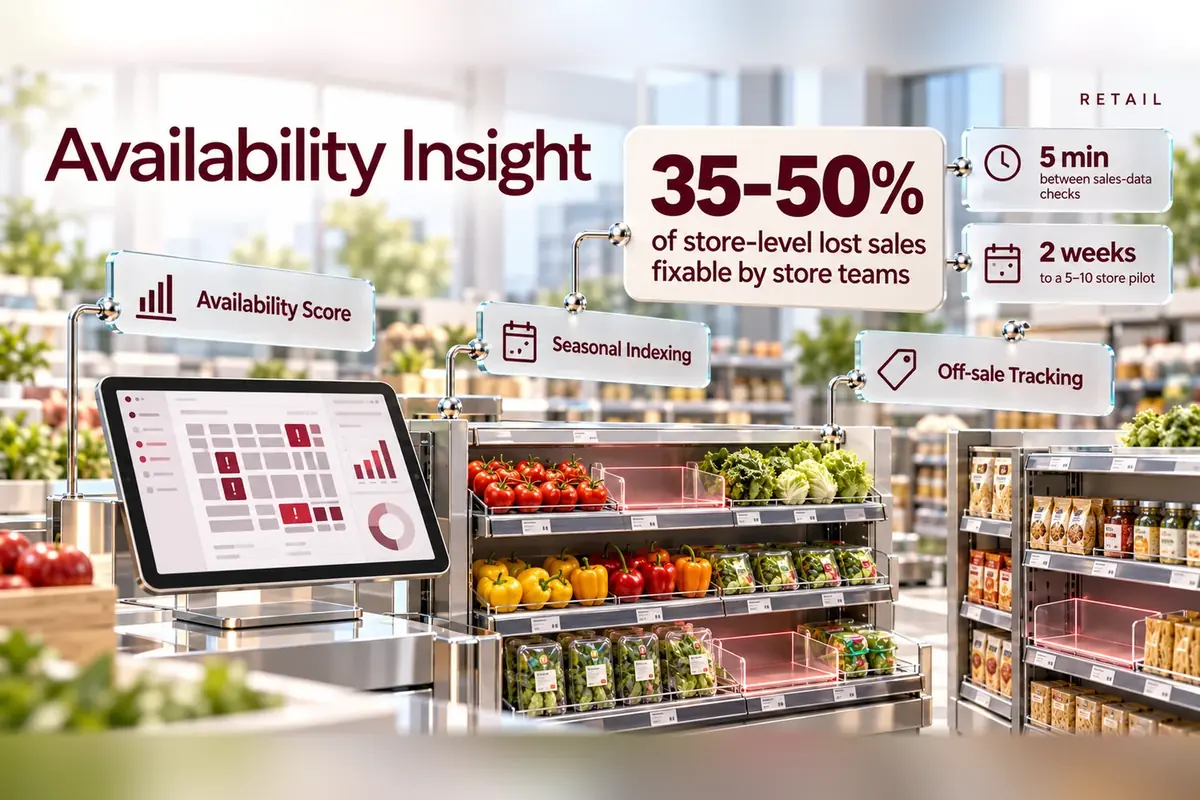
35–50%of store-level lost sales fixable by store teams
5 minbetween checks for new sales data
2 weeksto go live in a 5–10 store pilot
8 weeksto run across a full store estate

The Challenge

What stood in the way.

When an item is missing from the shelf, the shopper buys something else or leaves without it, and the sale is gone. Stock records alone often cannot show this, so the gap goes unnoticed until someone walks into the aisle.

Measure the loss

Retailers needed to see how much is being lost, item by item and store by store.

Separate gaps from slow sellers

A quiet hour can mean an empty shelf or simply an item that sells slowly.

Avoid alert fatigue

Store teams need a focused list of items to check, not a flood of false alarms.

One view for head office

Central teams needed a consistent view of availability across stores and departments.

Our Solution

How we answered it.

Availability Insight compares what each item should have sold with what it actually sold, using sales, inventory and ranging data. The gap between the two is lost sales, and lost sales drive the availability score, the store alerts and the head office reports.

  • ProblemA quiet hour can mean an empty shelf or a slow seller.
    Our answerOff-sale probability builds faster for fast sellers, so silence means more for a top line than a niche one.
  • ProblemPromotions and disruption distort normal sales.
    Our answerWe used a recency-weighted baseline with promotions and disruptions filtered out.
  • ProblemDemand differs by store, region and weather.
    Our answerSeasonal indexing clusters similar stores so expected sales reflect local conditions.
  • ProblemToo many alerts and stores stop reading them.
    Our answerGrace periods after delivery, repeat suppression, daily caps, lost-sales thresholds and validation prompts keep alerts focused.

How It Works

The parts that made the difference.

Availability score

An availability score and lost-sales value for every item in every store, where 100% means no availability problems.

Baseline sales

A recency-weighted historical average for each item in each store, with promotions and other disruptions filtered out.

Seasonal indexing

Similar stores are clustered, mainly by sales banding and optionally by region or format, so expected sales reflect local demand, promotions and weather.

Off-sale tracking

When an item stops selling in an hourly bucket, the system builds the probability that it is out of stock, faster for fast sellers, and records lost sales at 100%.

Results

What changed for the client.

We delivered a Snowflake-native version of Availability Insight that scores availability for every item in every store, detects likely out-of-stocks within hours and sends store teams focused, measurable alerts.

  • Availability score and lost-sales value for every item in every store
  • Likely out-of-stocks surfaced the same day through hourly time buckets
  • Sales checked for new data every 5 minutes and inventory every 30 minutes
  • One set of outputs serves the Store Alert App (Co-op, Dunnes), retailers' own systems (ASDA, Carrefour) and head office reporting
  • Pilot live in 5 to 10 stores within 2 weeks, with measurable results within 7 days
  • A full store estate running within eight weeks

Technology

What it was built with.

Part of our data engineering work.

  • Snowflake
  • Snowflake SQL
  • Snowpark Python 3.11
  • Snowflake Tasks
  • Snowflake Streams
  • Dynamic Tables
  • Azure Storage
  • Azure Event Grid

Let’s Talk

The next big thing starts with a conversation.

An idea, a challenge, a “what if”. Tell us what you have in mind, and we’ll figure out the next step together.

What happens next

  1. Share your ideaSend the form or book a call, whichever suits you.
  2. Discovery callWe talk through your goals, timeline and scope.
  3. A clear proposalA fixed price or monthly rate before any work begins.
Start a project

Tell us about your project

A few details and we’ll take it from there.

Book a 30-min call

Find us on